
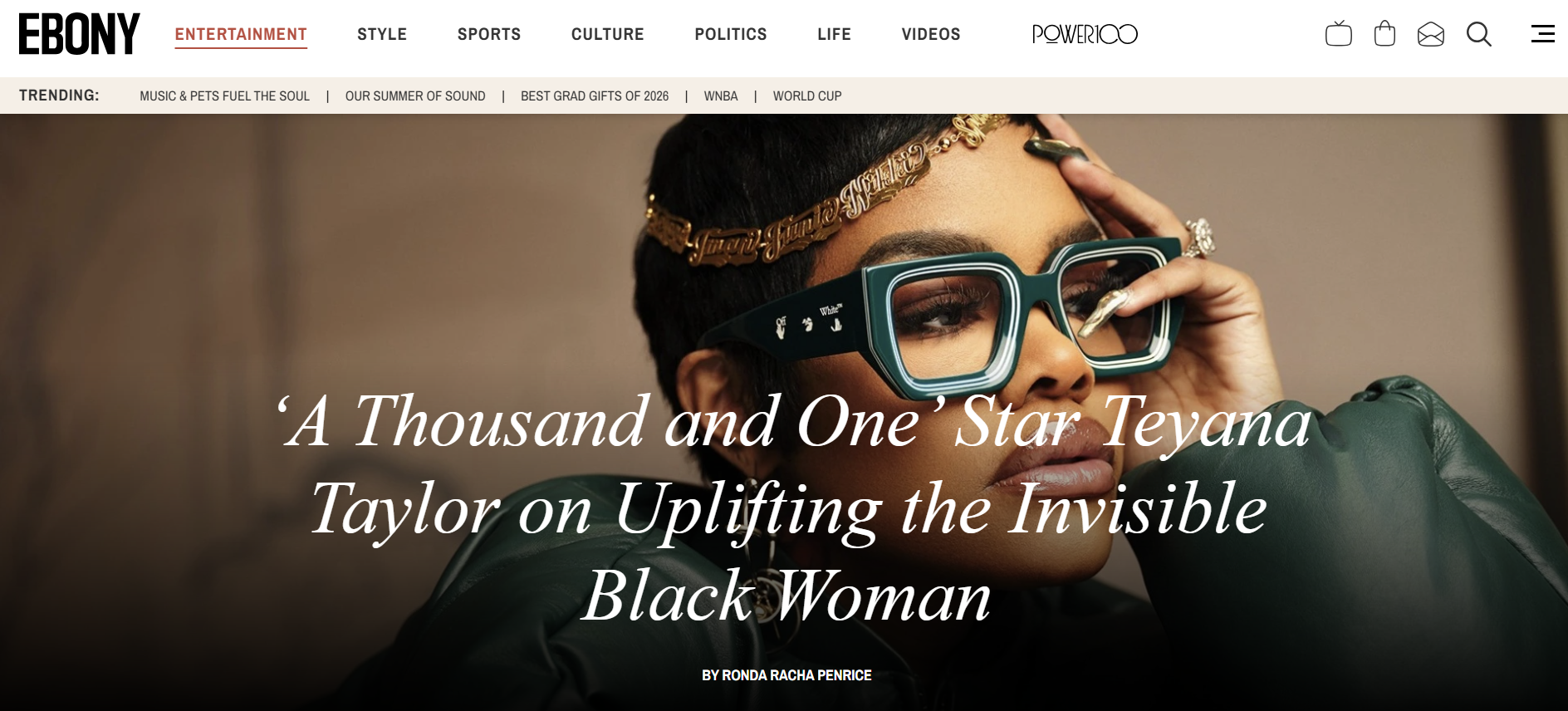
I ain't gone lie. Teyana Taylor's BET Awards moment as Icon of the Year got me thinking about my EBONY interview for A Thousand and One, the film for which she deserved all the praise. Coming here to post it has floored me. I wrote the ish out of this. And I don’t say that about all my work.
But this one was because I understand who Inez is. I know neighborhoods like that Harlem not because I once lived in Harlem, but because I grew up in one like it on the South Side of Chicago. And trust me we are almost never seen. I'm not a mother but I have witnessed the sacrifices they make when everything is stretched but their faith.
Heck I'm tearing up writing this. Here is the link and I pasted the first few paragraphs below: https://www.ebony.com/a-thousand-and-one-star-teyana-taylor-interview/
Shout out to that EBONY team who made it possible: EIC Marielle Bobo, Photographer Keith Major and always Managing Editor Joane Amay for her advocacy!!!! This is truly one of my most treasured pieces!
EXCERPT
A Thousand and One's heroine Inez is not the young, Black woman Hollywood favors. She’s not super gangster, a gold digger, drugged out, promiscuous, or an absentee mother. Instead, she’s determined to “go to war” for her kid, doing whatever needs to be done to give him the opportunities she never had as a rootless child of the system and collateral damage of the fallout from the harsh realities of growing up Black and poor in 1970s and 1980s New York City.
Black woman filmmaker A.V. Rockwell, tells her story with astonishing grace. Not that of the supportive mother who has the next super-athlete or child genius. But, rather, the one of the everyday Black woman who makes a way out of no way to create the home she never had, manifest the opportunities she could have never imagined, and unleash the love she was never given. Those truths ground Rockwell’s self-proclaimed love letter to Black women and allow Teyana Taylor to soar.
“I see my mom, I see my aunts, I see all the different women that are around us and those who have come before us,” Taylor tells EBONY, just days before A Thousand and One’s release.
Black womanhood in all its complexities is almost never explored on screen. “It’s standing up for us and it’s showing the strength and it’s showing that we don’t fold,” Taylor says of the film. “It’s also showing the harsh reality of how we’re treated and how much we’re not all the way protected, how much we have to be in survival mode.”